
TL;DR
Setting your graphic designer rates doesn’t have to be a guessing game. Your rate depends on your experience, the type of work, your location, and what you actually need to earn to run a sustainable business. This post walks you through how to think about pricing, what the numbers look like at different experience levels, a simple formula for calculating your floor rate, and how to present your prices in a way that builds client confidence from day one.
Figuring out your graphic designer rates is one of those things that feels like it should have a simple answer but really doesn’t. Ask five different designers and you’ll get five different numbers, five different frameworks, and at least two strong opinions about whether hourly pricing is even worth it anymore. That’s not a great starting point when you’re just trying to know what to charge.
Your graphic designer rates are personal. They depend on your experience level, the type of work you do, who you’re working with, and what you actually need to bring in to keep your business running. What this post will do is give you a framework to figure that out for yourself, backed by real data instead of guesswork.
Why Undercharging Feels Logical (But Costs You More in the Long Run)
When you’re just starting out, charging low feels responsible. You don’t have a long track record yet, so it seems fair to work at a discount until you’ve “earned” the right to charge more. That thinking makes sense on the surface, but it tends to create more problems than it solves.
Undercharging attracts clients who question every invoice, push back on revision limits, and treat design like a commodity. It also makes your rate harder to raise later because those same clients will be thrown off when your pricing jumps significantly. And beyond the relationship dynamics, there’s a real math problem: if your graphic designer rates don’t cover your actual expenses, you’ll need to take on more clients to compensate. More clients means less time and focus per project, and that eventually shows in the work.
Starting at the lower end of industry-standard graphic designer rates is very different from pricing yourself below market because you don’t feel ready yet. One is a reasonable starting point. The other tends to keep you stuck.
How to Structure Your Graphic Designer Rates
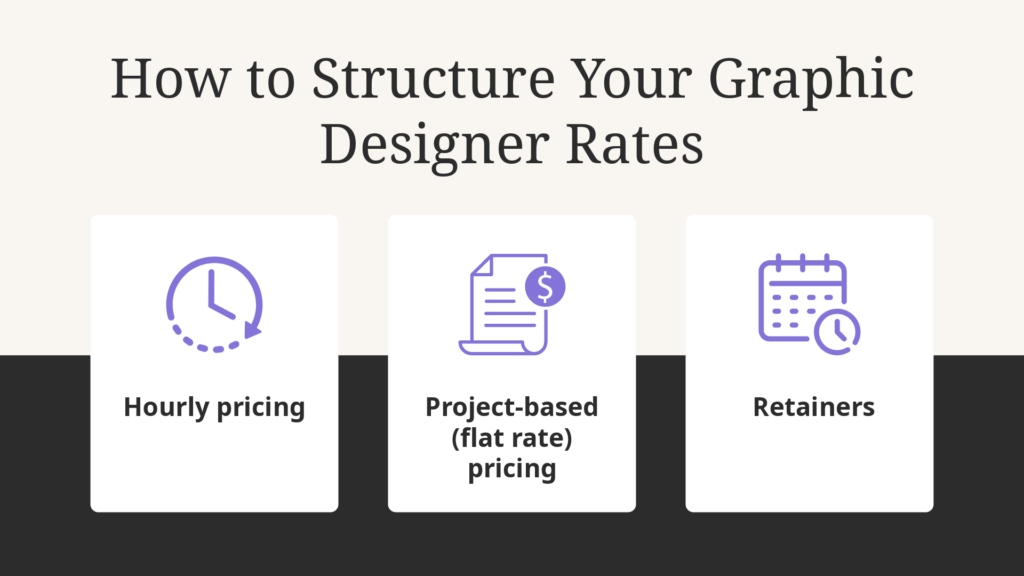
Before you settle on a number, it helps to understand which pricing model you’re working with, because the structure shapes everything else.
Hourly pricing is where most designers start. You charge by the hour, track your time, and invoice based on how long a project took. It’s simple and transparent. The downside is that it can work against you as you get faster and more experienced. If a project that used to take you six hours now takes three because you’ve done it a hundred times, hourly pricing means you’re getting paid less money for the same quality of work.
Project-based (flat rate) pricing means you quote a set fee for the entire project upfront. You scope the work, factor in your time, account for revisions, and settle on a number. Most designers eventually move toward this model because it rewards efficiency and puts the focus on the value you’re delivering, not the hours you’re logging.
Retainers are when a client pays you a fixed monthly fee for ongoing access to your work. If you have clients who need regular design support, retainer pricing is great for predictable income and more stable cash flow.
What Actually Affects Your Graphic Designer Rates
There’s no universal rate card for designers, but a handful of factors consistently shape what you can charge.
Experience. A designer two years in and a designer eight years in aren’t going to price the same thing, and that makes sense. Your rate should reflect how refined your process is, how quickly you deliver results, and how much strategic thinking you bring to the work.
Type of work. Logo design, full brand identity, packaging, editorial design, and motion graphics all carry different graphic designer rates. More specialized and strategy-heavy work generally commands more because fewer people can execute it well.
Location and client base. Graphic designer rates vary significantly by market. Designers working with clients in New York, London, or other major metros tend to price higher than those serving local small businesses in smaller cities. With remote work as the norm now, many designers price based on their client’s market rather than their own.
Your niche. Working with premium or established brands gives you more pricing leverage than working with early-stage startups on tight budgets. Who you work with is a major factor in what you can realistically charge.
What the Numbers Actually Look Like
Let’s get into real data, because this is usually what people want most.
According to the U.S. Bureau of Labor Statistics, the median annual wage for graphic designers was $61,300 in May 2024, which works out to roughly $29.47 per hour. That figure covers salaried, in-house designers. Freelance graphic designer rates tend to run higher because you’re covering your own taxes, software subscriptions, health insurance, and every other cost of running a business independently.
Across multiple industry sources, here’s how freelance graphic designer rates typically break down by experience:
| Experience Level | Hourly Range | Typical Project Fees |
|---|---|---|
| Beginner (0–2 years) | $25–$50/hr | $300–$1,500 |
| Mid-level (3–5 years) | $50–$85/hr | $1,500–$5,000 |
| Experienced (6+ years) | $85–$150+/hr | $5,000–$15,000+ |
These ranges shift depending on your niche, who your clients are, and where you’re located. Brand identity and strategy-led work tends to command more than one-off graphic assets. For more detailed benchmarks, the Graphic Artists Guild Handbook: Pricing & Ethical Guidelines is the most comprehensive industry reference out there, now in its 17th edition.

How to Calculate Your Floor Rate
Before you look at what other designers are charging, figure out your floor. This is the minimum amount you need to charge to make your business actually work, and it should drive your pricing before anything else does.
Start with your monthly expenses: rent, utilities, food, software, health insurance, savings, and anything else that’s fixed. Then add what you want to pay yourself, not just what you need to get by.
From there, account for the fact that not every working hour is a billable hour. Admin tasks, emails, marketing, pitching, and onboarding take up real time. A common benchmark is that around 50 to 60 percent of your working hours will go toward actual client work. If you work a standard 40-hour week, that’s roughly 80 to 96 billable hours per month.
So if you need to bring in $4,000 per month and you have 80 billable hours available, your minimum is $50 per hour before taxes. Add 25 to 30 percent on top for self-employment taxes and you’re looking at a real floor of around $62 to $65 per hour.
Running this calculation before you set your graphic designer rates takes most of the guesswork out of the process. You’re not picking a number because it sounds reasonable. You’re picking one because you’ve confirmed it actually works for your life. Bonsai’s Freelance Rate Explorer is a handy tool for cross-referencing your number against other designers in your experience range.
The Confidence Side of Pricing
No rate calculator is going to fix this part for you: a lot of designers drop their graphic designer rates before the client even says anything. They preemptively discount, add deliverables for free, or open with an apology before sharing their price. That habit is worth noticing.
When you present your rates with confidence, clients tend to receive them with confidence. Hesitation is contagious, and so is certainty.
A lot of what feels like a pricing problem is really a presentation problem. When your services and fees are clearly laid out in a polished document, pricing conversations go so much smoother. If you’re currently explaining your rates across a back-and-forth email thread or an awkward phone call, getting a proper services and pricing guide in place will make a bigger difference than you’d expect.
That’s exactly what my Services & Pricing Guide Template is built for. It gives you a professional, ready-to-send document that walks clients through what you offer, what it costs, and what working with you looks like, without you having to improvise that conversation every single time.
When to Raise Your Graphic Designer Rates
Your graphic designer rates shouldn’t stay the same forever. As your skills develop, your portfolio grows, and you get clearer on who you serve, your pricing should reflect where you actually are now.
A good rule of thumb is to revisit your graphic designer rates every six to twelve months. You don’t have to increase them every time, but you should check in and ask whether your current pricing still makes sense.
A few signals that it might be time to raise your rates: you’re booked out consistently with no breathing room, you’re regularly turning away projects, or you feel low-key resentment toward certain clients or work. Any of those is a sign worth paying attention to.
For existing clients, give notice before a rate increase, ideally four to six weeks in advance. For new clients, there’s no announcement needed. Just quote at your new rate and go from there.
Next Steps: Start This Week
If you’ve been putting off sorting out your pricing, this is a good week to change that. Here’s where to start:
1. Run the floor rate calculation. Pull up your monthly expenses and estimate your billable hours. Do the math before you look at what anyone else is charging.
2. Research rates in your niche. Design communities on Reddit, Facebook groups, and resources like the Bonsai Freelance Rate Explorer are solid places to find real benchmarks from working designers.
3. Get your pricing out of your email drafts and into a proper document. If you’re still sending informal pricing info to clients, a polished presentation will immediately change how they receive your graphic designer rates.
The Services & Pricing Guide Template is designed to help you do exactly that. It takes the guesswork out of how to present your services and fees in a way that builds confidence for both you and your client, from your very first inquiry.
Frequently Asked Questions
What should I charge as a beginner graphic designer?
At 0 to 2 years of experience, freelance graphic designer rates typically fall between $25 and $50 per hour, with project fees ranging from around $300 to $1,500 depending on scope. The most important step before picking a number is calculating your floor rate so you know you’re not working below what you actually need to bring in.
Should I charge hourly or per project?
Both work, but most experienced designers eventually move toward project-based pricing because it focuses the conversation on value rather than time, and it rewards you for getting faster and more efficient at your work. Hourly is a fine place to start when you’re still scoping projects and learning how long things take.
How do I raise my rates with existing clients?
Give them notice, ideally four to six weeks before the new rate takes effect. Keep it professional and matter-of-fact: let them know your rates are increasing as of a specific date and what the new rate will be. Most clients who value your work will understand, especially if you’ve built a solid relationship.
How do I know if my graphic designer rates are too low?
A few signs: you’re consistently booked out with no room to take on new work, you’re turning down projects regularly, or you feel resentment around certain clients. Any of those is a good signal to revisit your pricing.
Do graphic designer rates vary by location?
Yes. Designers working with clients in major metro areas or in the US and Western Europe generally charge more than those in smaller markets. With remote work being so common now, many designers price based on their client’s market rather than their own, which can open up your earning potential considerably.
What is the Graphic Artists Guild Handbook?
The Graphic Artists Guild Handbook: Pricing & Ethical Guidelines is one of the most comprehensive industry references available for designers and illustrators. It covers pricing benchmarks, business practices, contracts, and ethical standards. The 17th edition was released in 2025 and is worth having on your shelf if you’re serious about running your design business well.