
TL;DR
My brand strategy questionnaire didn’t always look like the one I use today. Early on, I sent long forms with a question for everything I could possibly want to know, and I got back one word answers, half finished sentences, and sometimes nothing at all. After that happened enough times, I rebuilt the whole thing around fewer, sharper questions, and one client’s answer to a single question ended up changing the entire direction of that project.
A brand strategy questionnaire only earns its place in your process if it gets a client thinking instead of guessing, and for a long time mine did neither. When I first started taking on branding projects, I sent out a questionnaire that ran long, with a question for nearly everything I thought I might need down the road. What came back was rough. One word answers. Sentences that trailed off halfway through. Sometimes a client got three questions in, felt overwhelmed, and never finished it at all.
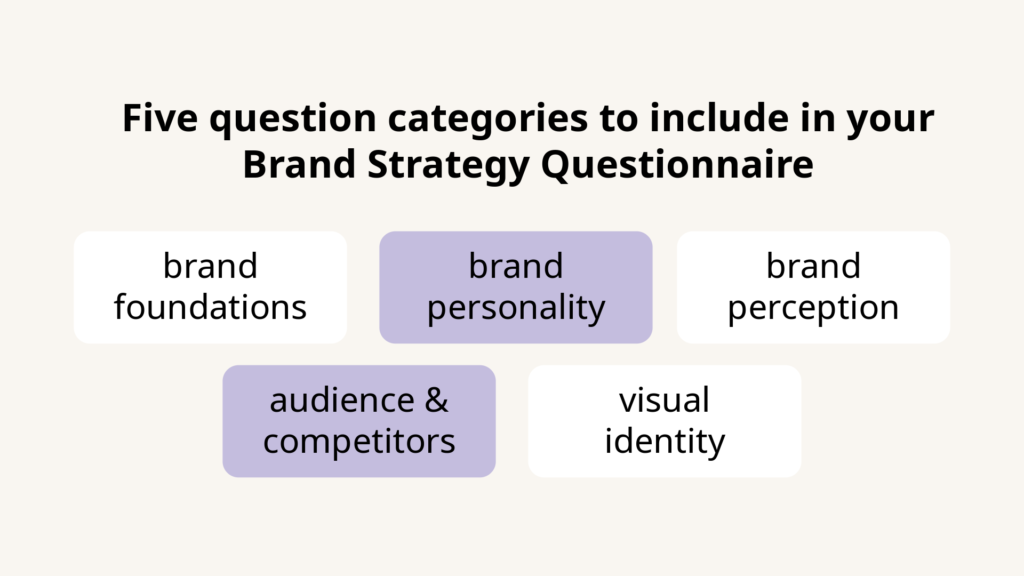
After that happened enough times, I stopped blaming the clients and started looking at the document itself. I cut it down from around twenty questions to twelve, sorted into five categories: brand foundations, brand personality, brand perception, audience and competitors, and visual identity. What follows is a look at a few of those questions, the reasoning behind them, and a story about a client answer that ended up steering an entire project somewhere I never expected.
Why I Rebuilt My Brand Strategy Questionnaire From Scratch
I can’t point to one single moment that made me sit down and rewrite everything. It was more of a slow realization that kept repeating itself. I’d send the long version, wait, and get back answers so vague I couldn’t design from them. “Modern but timeless” for the style question. “Everyone” for the audience question. Whole sections left blank because the client ran out of steam halfway through.
A twenty question form with no context behind any of it reads like homework, and most people give homework the minimum effort it takes to hand it in. That’s not a knock on the clients, it’s just how a long, generic form tends to get treated. Once I understood that, the fix wasn’t piling on more questions. It was fewer, better ones, asked in a way that made the client want to actually sit with the answer instead of rushing past it.
That lines up with what other designers have landed on too. Dribbble’s roundup of key questions to ask clients before starting a design project makes the case for asking “why” repeatedly instead of accepting a client’s first answer, which is essentially what I ended up doing by rebuilding mine around fewer, more pointed questions instead of a long list of surface-level ones. That shift is the whole reason my brand strategy questionnaire looks the way it does today.
The Questions My Brand Strategy Questionnaire Actually Asks
My full brand strategy questionnaire has twelve questions split across five categories, and I’m not going to hand over the whole thing here since that’s the document I actually sell. But here’s one question from each category, and why it earns its spot.
Brand foundations: “What’s the real reason you’re doing this rebrand or launch right now?” Not the surface reason. The real one. Sometimes it’s growth. Sometimes it’s a founder who’s simply tired of a logo they never liked. Sometimes it’s a business that’s shifted direction without having said that part out loud yet. This question surfaces the thing that’s actually driving the project, and I’ve had it change my entire approach more than once.
Brand personality: “If your business walked into a room, how would people describe it in the first thirty seconds?” This replaced my old “describe your brand personality” question, which almost always got me three safe adjectives and nothing more. Framing it as a room full of strangers gets people picturing a scene instead of picking words off a list, and the answers I get back actually sound like a business instead of a mood board.
Brand perception: “What’s the one thing you never want a customer to feel when they interact with your brand?” This one sounds like the opposite of a strategy question, but negative space is often clearer than positive space. Clients can usually tell me what they don’t want faster and more specifically than what they do want, and that answer becomes a guardrail I can hold every design decision up against later.
Audience and competitors: “Who is this brand not for?” I ask this instead of the standard target audience question, because “who is your audience” almost always gets me “everyone,” and that answer helps nobody. Asking who a brand is deliberately not for forces a client to draw a line, and that line tells me more about their actual audience than a demographic breakdown ever could.
Visual identity: “Name a brand outside your industry you admire, and tell me exactly what draws you to it.” I stopped asking for competitor brands only, because that answer just tells me who else is in the space. Asking for something outside the industry gets past the “make it like my competitor” instinct and into what a client actually responds to emotionally, which is far more useful when I start building out a visual direction.
Five questions out of twelve, and every one of them earns its place because the answer changes what I actually build, not just what I think I know about a business.
The Client Answer That Changed My Whole Direction
A few years ago I had a client come to me for a full rebrand, and on paper the brief looked straightforward. Established business, clear product, a founder who wanted something that felt more premium than what they had. I sent over my brand strategy questionnaire expecting fairly predictable answers, and most of them were.
Then I got to the question about the real reason behind the rebrand right now. The client’s answer wasn’t about looking more premium at all. It turned out the business had shifted who it actually served over the past year, and the old brand no longer spoke to that audience even a little. The founder hadn’t led with that in our first call, maybe because it felt like a smaller detail than “we want a new look.”
That one answer moved the entire project. Instead of a polish job on an existing direction, we were building a brand for an audience the old identity had never been speaking to at all. If that question hadn’t been sitting in my brand strategy questionnaire, I’d have found out three weeks into the design phase, probably after a round of concepts that would have needed to be scrapped.
How I Use a Brand Strategy Questionnaire Before Any Design Starts
Once the answers come back, I don’t jump straight to sketching or moodboards. I read through the whole thing once for the facts, then a second time looking for repetition. Words a client keeps circling back to without noticing. Contradictions between what they said they wanted and what they said they didn’t want. Those patterns become the backbone of the direction I bring to the first strategy conversation.
A brand strategy questionnaire only works if you actually use what it hands you instead of treating it as a box to check before the fun part starts. My full twelve questions take a client about fifteen to twenty minutes to answer properly, which is short enough that they don’t rush it and long enough to get real material out of it. That balance is the whole point.
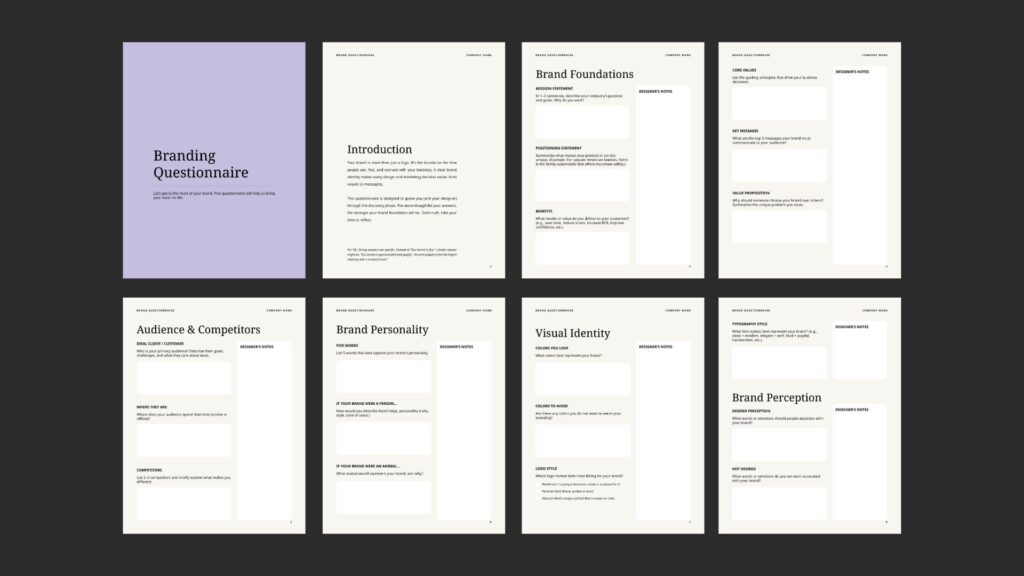
If you’re realizing your own questionnaire could use a rebuild, you don’t have to start from a blank page. My Branding Questionnaire Template already has prompts built around getting clients past the buzzwords, available in Google Forms, Notion, or fillable PDF depending on how you run client work. It also pairs well with the breakdown I wrote on brand discovery versus brand strategy, if you want to see where a questionnaire like this actually fits in the bigger picture of a project.
Next Steps: Start This Week
- Pull up the questionnaire you currently send clients and count how many questions could realistically be answered in one word. Rewrite or cut every single one.
- Add a version of the “who is this brand not for” question to your audience section if you don’t already ask something like it. It tends to surface more than the standard target audience question ever does.
- Time yourself answering your own questionnaire as if you were the client. If it takes longer than twenty minutes, it’s too long.
- Decide where in your process this document actually goes out, and check it against the piece I wrote on brand strategy documents, workshops, and questionnaires if you’re not sure which tool fits which project.
- If you’d rather skip rebuilding this from scratch, grab the Branding Questionnaire Template and use it on the next client that signs on.
Frequently Asked Questions
How many questions should a brand strategy questionnaire have?
There’s no fixed number, but fewer, sharper questions consistently outperform long forms. Mine sits at twelve, sorted into five categories, and it gets far more usable, specific answers than the twenty question version I started with, since clients give more thought to a document that doesn’t feel like an exam.
Should I send my brand strategy questionnaire before or after our first call?
Before. Sending it ahead gives clients time to actually think through their answers instead of improvising them live on a call, and it gives you material to reference once you do talk.
What if a client's answers still come back vague?
A short follow up call focused specifically on the vague answers usually resolves it faster than trying to fix things over email. It’s also worth checking whether the question itself invites a one word answer, since that’s often the real issue.
Can I reuse the same brand strategy questionnaire for every client?
Yes, with light adjustments. The core structure holds up across most branding projects, though you may want to tweak a question or two depending on the industry or whether it’s a full rebrand versus a brand built from nothing.